Merrimack Conservation Partnership Opens New 2025 Grant Rounds

The Merrimack Conservation Partnership (MCP) today released a request for proposals for its 2025 grant programs:

  • Land Conservation Grant Program, which funds transaction-related expenses on land conservation projects in the lower Merrimack Valley watershed of southern New Hampshire and northern Massachusetts. The program underwrites transaction costs—appraisals, surveys, title research, staff time, etc.—on conservation transactions that protect land identified as a priority in the Merrimack Valley Regional Conservation Plan (2014). The MCP has $117,434 to re-grant in 2025 for this grant program.
  • Environmental Science, Education and Outreach Grant Program, which provides funding for environmental science, education and outreach activities related directly to the Merrimack River or its watershed.  Funds can be used for activities such as youth or public environmental educational activities, development of outreach and educational materials, river clean ups, water quality testing and monitoring activities, and other related activities. The MCP has $25,000 to re-grant in 2025 for this grant program.

The grant programs are privately funded and administered by the Society for the Protection of New Hampshire Forests on behalf of the Merrimack Conservation Partnership. Non-profit land trusts, municipalities, and state agencies are all eligible to apply for an MCP grant.

The Merrimack Conservation Partnership is a regional conservation alliance formed to protect the southern portion of the greater Merrimack River watershed in New Hampshire and Massachusetts through accelerated land and water protection, advocacy, restoration, outreach and education.  The Partnership works by supporting and fostering collaboration, coordination, and innovation among partner organizations to strengthen our individual and collective efforts toward achieving the shared goal of a clean, healthy Merrimack River.

The Merrimack watershed is home to more than 2.6 million people–1.87 million in Massachusetts and 748,000 in New Hampshire. The 2010 U.S. Forest Service report, Forests on the Edge, identified the Merrimack River watershed as the most threatened in the nation in terms of projected loss of private forest land over the next twenty years.

Working together, the Partnership has developed a science-driven, consensus-based land conservation plan that integrates the best available natural resource data with expert judgment to prioritize land protection to protect water quality (especially drinking water supplies), preserve aquatic and terrestrial ecosystems, conserve the region’s working farms and forests, and provide recreational open space. The Merrimack Conservation Plan identifies 1.3 million acres of land, representing about 54% of the watershed’s total land area, as a priority for conservation. As of the completion of the plan in 2014, only 23% of these priority acres was permanently conserved.

Before applying for an MCP grant, applicants should carefully review the request for proposals and application materials. These are available at the “Grants” section of the MCP website at http://merrimackconservationpartnership.org. The website also includes information on the Merrimack Valley region and conservation plan, maps, a list of towns in the region, etc.

Projects must be located in the towns listed on the website to be eligible to apply for funding.

Completed applications must be received no later than 5:00 p.m. on August 29, 2025. Completed applications may be submitted electronically to ccolton@forestsociety.org. Completed applications may also be sent by mail and must be postmarked no later than August 29, 2025. Mail applications to:  Connie Colton, Society for the Protection of New Hampshire Forests, 54 Portsmouth Street, Concord, NH  03301. Successful grant applicants will be notified by October 10, 2025.

For all questions regarding the grant program and the application process, please contact Brian Hotz at (603) 224-9945 x 316 or bhotz@forestsociety.org.
Merrimack Conservation Partnership Announces its 2023 Environmental Science, Education and Outreach Grant Awards

The Merrimack Conservation Partnership (MCP) announced the 2023 recipients of its seventh round of Environmental Science, Education and Outreach grants in the Merrimack Valley Watershed region of New Hampshire and Massachusetts. In this round of grants, the MCP awarded grants totaling $15,000 to eight projects that will help fund environmental science, education, and outreach activities related directly to the Merrimack River or its watershed. Funds can be used for activities such as youth or public environmental educational activities, development of outreach and educational materials, river clean ups, water quality testing and monitoring activities, and other science, education, and outreach efforts.

In 2010, the Merrimack was identified by the US Forest Service as the most threatened watershed in the nation in terms of projected loss of private forestland over the next 20 years. The two-state region of the Merrimack Watershed spans a total of 2.1 million acres and 3,275 square miles, of which 54% is in New Hampshire and 46% in Massachusetts. The Merrimack River starts in Franklin, NH and flows through eight of New Hampshire’s largest cities, then continues into Massachusetts to its mouth at Newburyport.

Launched in 2012, the Merrimack Conservation Partnership is a collaborative effort of private organizations and public agencies working on land conservation in the Merrimack Valley Watershed. The partners share a vision of conserving (on a strictly willing-seller/donor basis) the region’s most ecologically significant forests and the key connections between them for wildlife passage and human recreation.

The 2023 Grant Award winners are:

Applicant: Upper Merrimack Watershed Association
MCP Grant Award: $2,250
Estimated Total Project Costs: $33,586

Summary:
Biological Monitoring in the Upper Merrimack River and Tributaries
Since 1994, the Upper Merrimack Watershed Association’s (UMWA) Monitoring Program has been a volunteer-administered program providing data to municipal, state, and federal agencies. Each winter, volunteers are trained to identify and enumerate benthic macroinvertebrates, providing a long-term assessment of river conditions. Funding granted will be used to purchase stereo microscopes to offer expanded opportunities for volunteers to participate and generate accurate data. Information gathered will be provided to the upper Merrimack community through MerrimackRiver.org, events, media releases, email marketing, blog/forum and social media.

Applicant:  Merrimack River Watershed Council
MCP Grant Award:  $1,125
Total Project Costs:  $3,125

Summary:
Urban Resilience Program Associate
The Merrimack River Watershed Council’s Urban Resilience Program Associate works on environmental issues in the watershed, especially in environment justice urban communities, including youth environmental education, trash clean-up events that mitigate the degradation of water quality, and water quality monitoring. This grant will help fund the program associate’s time to create educational materials, programs and activities; organize outreach materials and recruit volunteers to implement trash clean-up events; and conduct water quality monitoring activities with volunteers through 2024.

Continue reading

Merrimack Conservation Partnership Announces 2023 Land Transaction Grant Awards

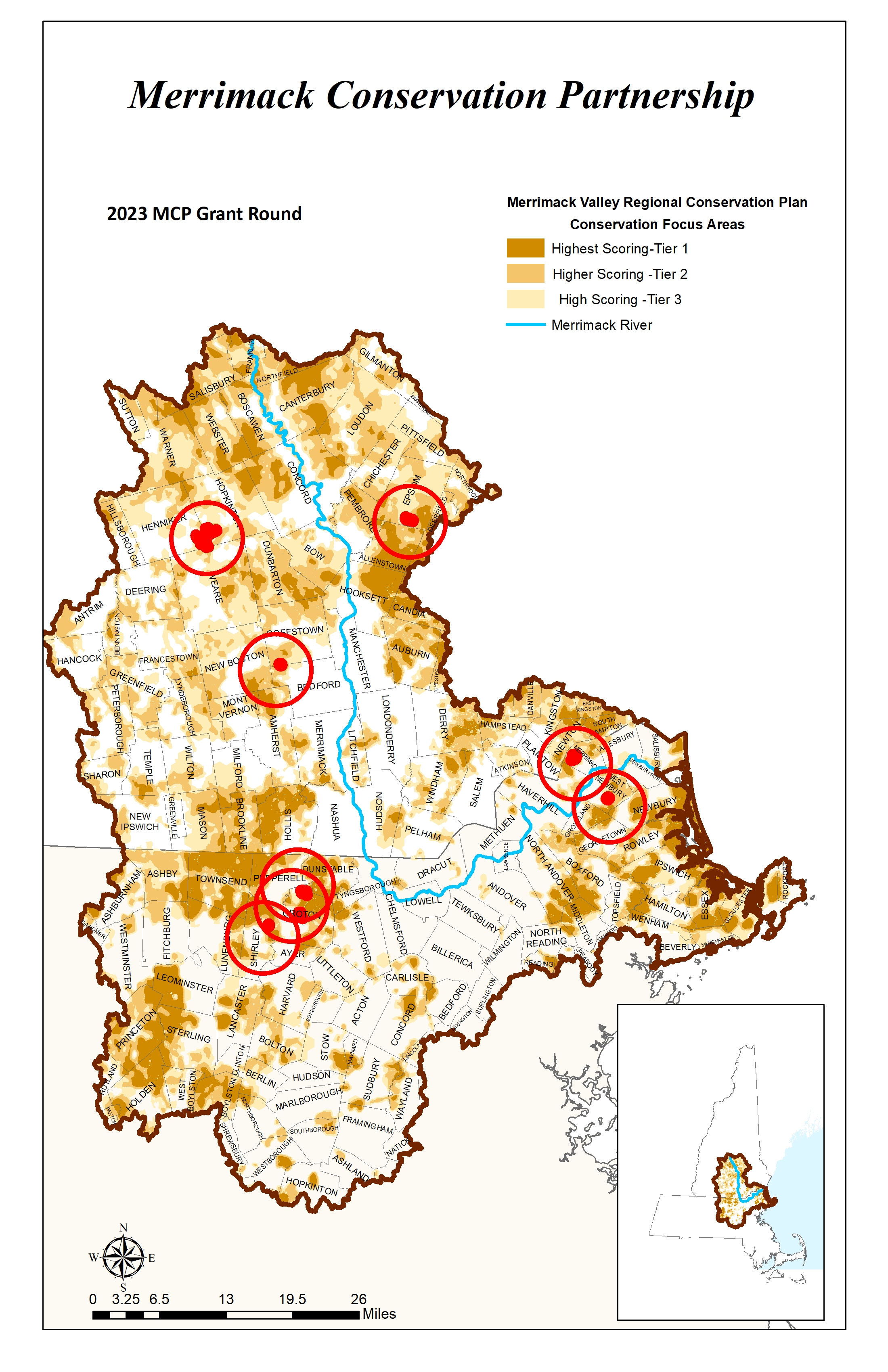
The Merrimack Conservation Partnership (MCP) announced the 2023 recipients of its tenth round of Land Conservation Grants, which help underwrite conservation projects that protect the ecologically important Merrimack Valley Watershed region of New Hampshire and Massachusetts. In the latest grant round, the MCP awarded grants totaling $68,697 to six projects that will conserve a total of approximately 904 acres of land. The total value of the land to be protected in these latest grant rounds is conservatively estimated at $4.23 million.

In 2010, the Merrimack was identified by the US Forest Service as the most threatened watershed in the nation in terms of projected loss of private forestland over the next 20 years. The two-state region of the Merrimack Watershed spans a total of 2.1 million acres and 3,275 square miles of which 54% is in New Hampshire and 46% in Massachusetts. The Merrimack River starts in Franklin, New Hampshire and flows through eight of New Hampshire’s largest cities, then continues through Massachusetts to its mouth at Newburyport.

Launched in 2012, the Merrimack Conservation Partnership is a collaborative effort of private organizations and public agencies working on land conservation in the Merrimack Valley Watershed. The partners share a vision of conserving (on a strictly willing-seller/donor basis) the region’s most ecologically significant forests and the key connections between them for wildlife passage and human recreation.

The Merrimack Conservation Partnership Land Conservation Grants program underwrites transaction costs—appraisals, surveys, title research, staff time, etc.—on conservation transactions that protect land identified in the Merrimack Valley Regional Conservation Plan.

Below is a list of the 2023 grant recipients and a brief description of their projects.

Hoyt Farm in Merrimac, MA

Applicant:  Essex County Greenbelt Association
Acres to be conserved:  120
Protection Method:  Land Purchase
MCP Grant Award:  $10,000
Estimated Total Project Cost:  $1,465,600

Essex County Greenbelt Association (Greenbelt) seeks to preserve Hoyt Farm by acquiring and owning these 120 acres. This farm, one of many former dairies in Essex County, is currently either in hay, corn or other vegetables, and is periodically grazed by 6 cows by the owner. Hoyt Farm is rich in natural resources: the headwaters to the City of Haverhill drinking water supply, intact mature forests, and farmland soils. The property shares its northern border with the Merrimac Town Forest and Greenbelt plans to extend trails from the Town Forest onto Hoyt Farm. Protecting Hoyt Farm will also expand a wildlife corridor mapped as Priority Habitat for Rare Species by MassWildlife’s Natural Heritage and Endangered Species Program.

Evergreen Farm in Salisbury, MA

Applicant: Essex County Greenbelt Association
Acres to be conserved: 36
Protection Method: Land Purchase
MCP Grant Award: $10,000
Estimated Total Project Cost: $1,959,500

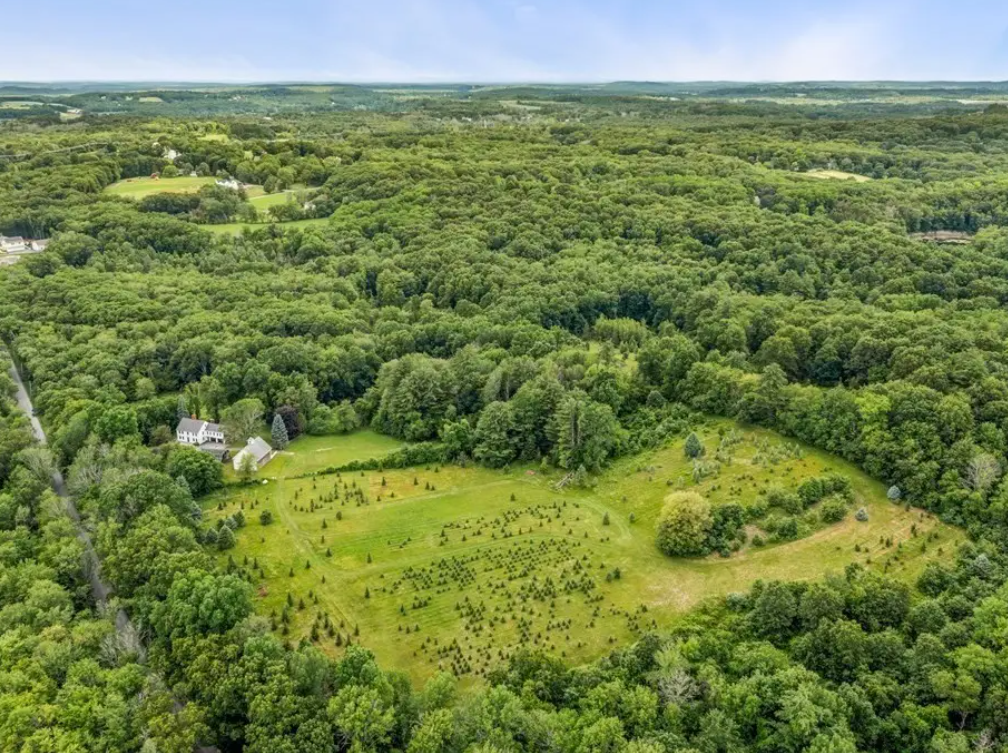
Essex County Greenbelt Association (Greenbelt) has an accepted offer to purchase a former Christmas Tree Farm adjacent to the Crane Pond Wildlife Management Area (WMA). Once Greenbelt has acquired the property, 18 acres will be protected via a sale to the Massachusetts Department of Fish & Game, expanding the Crane Pond WMA, and will be open to the public. The remaining 18 acres will be sold to a private party subject to a conservation easement permitting farming outside of wetland buffers with a farm conservation plan, wildlife habitat management, and passive recreational use. 

Casella, Priest and Hallet Conservation Lands in Groton, MA

Applicant: Groton Conservation Trust
Acres to be conserved: 199.73
Protection Method: Donated Conservation Restrictions
MCP Grant Award: $1,197
Estimated Total Project Cost: $39,595

The Groton Conservation Trust (GCT) engaged in a partnership with the Town of Groton, MA in 2023 to permanently protect three parcels in Groton. The Town purchased the properties in fee and the GCT was granted the conservation restrictions for the three properties. This is the latest effort of a longstanding partnership between the Town and the GCT in which the two organizations share expertise and resources for the shared goal of permanent protection of local land with high conservation value. These parcels add to existing land held in permanent protection and include significant acreage of estimated habitat of rare wildlife. In addition, all three parcels are open to the public for non-motorized recreation and include trails maintained by the Town Trails Committee.

Continue reading

Up the Merrimack River with Thoreau

thoreauOn this day, Aug. 31, 175 years ago, Henry David Thoreau and his elder brother John set out on an expedition from Concord, Massachusetts, in a homemade wooden boat. Over the course of two weeks they traveled first downstream on the Concord River, then upstream along the Merrimack River past Nashua, Manchester, and Concord, NH. That trip would become the backbone of Thoreau’s first book, A Week on the Concord and Merrimack Rivers, published ten years later in 1849.

Today, 175 years after Thoreau’s river expedition, the Merrimack still flows. But it is threatened. In 2010 the US Forest Service identified the Merrimack watershed as the most threatened in the nation, due to projections of population growth and our reliance on land intensive suburban development patterns. In response, 33 organizations in New Hampshire and Massachusetts recently completed a comprehensive land conservation plan for the Merrimack River watershed. The good news is that there is still forestland that, once conserved, can help maintain the health and vitality of the river.

– Excerpted from the Forest Journal, published August 31, 2014. Read More…